
Reviewed · CITY TOURS
Soviet Yerevan: Small-Group City Experience
Soviet Yerevan is not what you expect. This small-group route turns familiar streets into a guided timeline, from Lenin Square to a 1937 children’s railway. It is an easy way to understand how the USSR shaped daily life in Armenia, without getting stuck in museum-only mode.
I like the tight pacing and methodical route. You get five focused stops, with built-in time to look closely and take photos, not sprint from one landmark to the next. I also love the food and texture of the experience, from market sampling to Soviet-style treats that make the stories feel real.
The main thing to consider is that this tour is designed for Soviet context, so if you only want post-Soviet highlights, the theme may feel narrow. Also, some walking and transit time are part of the plan, so comfy shoes help.
In This Review
- Key points before you go
- Soviet Yerevan, in four hours and five stops
- Meeting at Republic Square, then walking into the USSR timeline
- Stop 1: Republic Square, the place Lenin Square used to be
- Stop 2: Sasuntsi Davit Street, a metro station opened in 1981
- Stop 3: Malatia-Sebastia market, the area known as Bangladesh
- Stop 4: Beknazarian Street and the CCCP apartment district feel
- Stop 5: The Children’s Railway, built in 1937 and still running
- Who this tour suits best
- Practical tips to get the most from the 4-hour format
- Value check: what you get for $65
- Should you book Soviet Yerevan?
- FAQ
- What is the duration of the Soviet Yerevan tour?
- How much does the tour cost?
- Is the tour offered in English?
- What is the maximum group size?
- What is included in the price?
- Are admission tickets required for the stops?
- Where does the tour start and end?
- When is the tour available?
- Can I cancel for a full refund?
Key points before you go
Small-group size (max 6) means more conversation and fewer crowd bottlenecks.
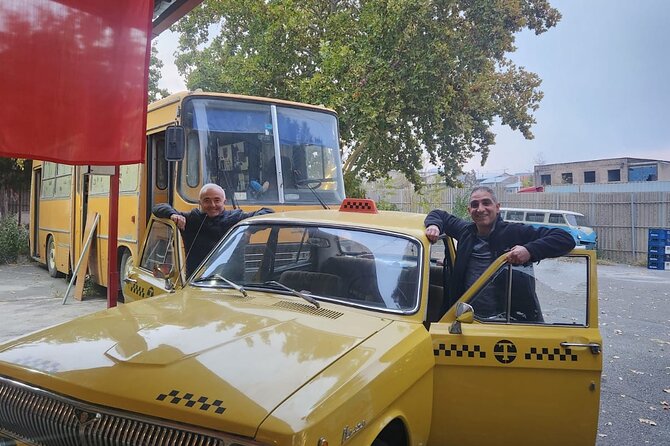
Metro plus Soviet-style van helps you cover ground efficiently and feels like part of the story.
Hands-on food stops include market sweets like perashki and ponchik.
CCCP apartment district details connect housing blocks to what was built in Soviet times.
Children’s Railway ticket included at a station and locomotive that date back to 1937.
English mobile ticket makes last-minute logistics simple.
Yet more Things to Do in Yerevan
- Group Tour: Garni, Symphony of Stones, Geghard, Lavash Baking
★ 5.0 · 1,042 reviews - Group Tour: Lake Sevan (Sevanavank), Dilijan (Goshavank, Haghartsin)
★ 5.0 · 1,036 reviews - Garni & Geghard Small-Group Day Trip with Lavash Baking
★ 4.8 · 881 reviews
Soviet Yerevan, in four hours and five stops
This is a half-day city experience built for people who want more than photos of Soviet-era monuments. Instead of only pointing at statues, the route connects big civic symbols to the everyday places where people moved, shopped, lived, and even played. The result is a Soviet Yerevan that feels practical, not abstract.
At $65 per person for about 4 hours, it is good value if you like guided context. You are not just paying for narration. The price also covers a local expert guide, metro ride and a Soviet-style van, snacks, and an included admission ticket for the Children’s Railway. Most of the other stops are listed as free, which helps keep your budget predictable.
One more plus: the group cap is 6 travelers. That small number matters here because the tour leans into questions and conversation, especially at the stops where the Soviet system shaped daily routines.
Meeting at Republic Square, then walking into the USSR timeline
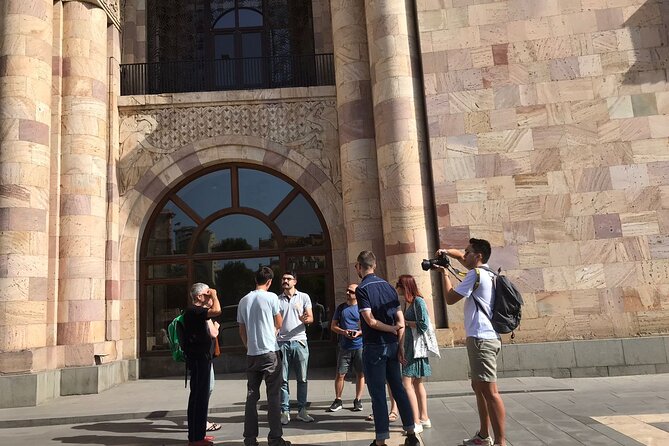
The tour starts at the Ministry of Foreign Affairs, Government House #2, right by Republic Square. That location is smart, because it anchors the story in the city’s most central, most symbolic space. You will likely begin with a short orientation, then head out in a logical flow rather than bouncing around Yerevan.
Your afternoon ends at Diana Abgar Park in Arami poghots. That gives you a natural finish point where you can keep exploring on your own.
From the format, it feels like a tour designed to be methodical. You will not be handed a grab bag of random stops. Instead, each segment has a reason, and the guide connects the dots as you go. One English-speaking guide name that comes up in the tour experience is Marine, praised for personal storytelling and for tossing in Soviet jokes that make the history easier to hold onto.
Stop 1: Republic Square, the place Lenin Square used to be
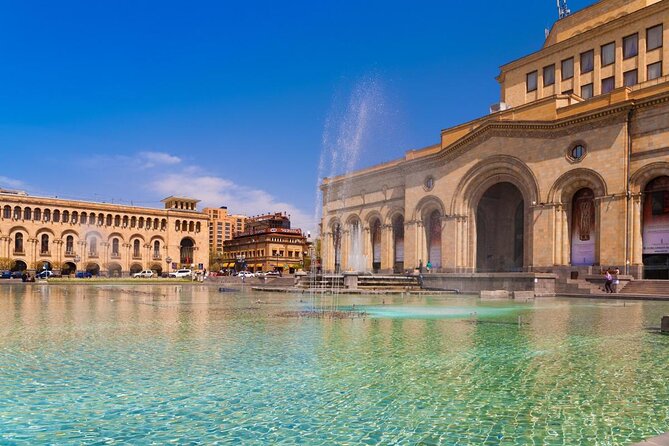
Republic Square is the official heart of Yerevan, and it has a Soviet layer you can still feel. During the Soviet period, it was called Lenin Square, and a statue of Vladimir Lenin stood here. Soviet parades and celebrations took place regularly, with the rhythm described as twice a year until 1988, originally three times.
After Armenia gained independence, the Lenin statue was removed and the square was renamed. That change matters. It is not just a label swap. It is a public statement about power, identity, and what the city wanted to represent.
You have about 15 minutes at this stop. That is enough time to take a few strong photos and notice details without turning it into a long lecture. Practical tip: arrive ready to look up and around. This square reads differently depending on what angle you view it from.
More of Yerevan on foot and by car:
- Yerevan city tour with drinks in a classic car with photography★ 5.0 · 41 reviews
- Private Tbilisi Tour from Yerevan (main sights of old and new city, cable car)★ 5.0 · 39 reviews
- Private Yerevan City Tour: Erebuni, Matenadaran & Tsitsernakaberd Museums★ 5.0 · 34 reviews
- Walking Yerevan City Tour with 5 Wine & 10 years-old brandy★ 5.0 · 17 reviews
Stop 2: Sasuntsi Davit Street, a metro station opened in 1981
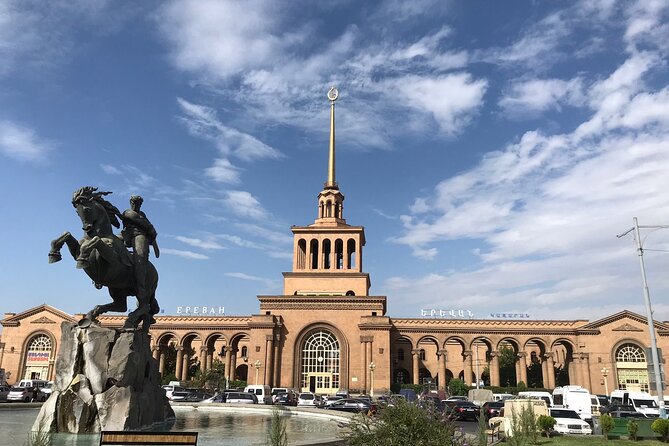
Next comes Sasuntsi Davit Street, which may not be the first Soviet stop you think of. That is exactly why it works. This metro station is one of the original metro stations in Yerevan. It opened to the public on 7 March 1981.
What makes it more than a date on a plaque is the connection to transportation infrastructure. It is linked to the adjacent Yerevan railway station by a pedestrian tunnel. So even if you never ride trains, you can understand the Soviet mindset behind planning: move people efficiently, and connect key hubs.
The name also ties modern geography to cultural references. It is named for David of Sassoun, and a statue of him stands outside the railway station. That cultural naming is a nice reminder that Soviet design often intersected local identity rather than erasing it completely.
You get about 35 minutes here. That extra time is useful for people-watching and for understanding how transit routes shape a city. If you enjoy architecture, this stop gives you “infrastructure history,” not just monument history.
Stop 3: Malatia-Sebastia market, the area known as Bangladesh
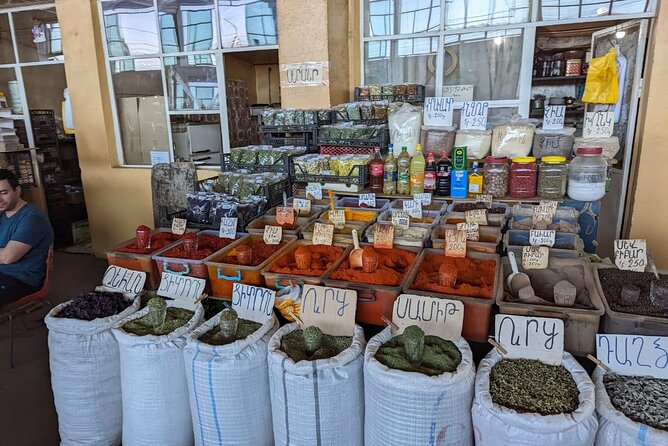
Then the tour shifts to the city edge, into Malatia-Sebastia. Here the story turns from official space to everyday commerce. An area within this district is known as Bangladesh, and it is famous for selling agricultural products.
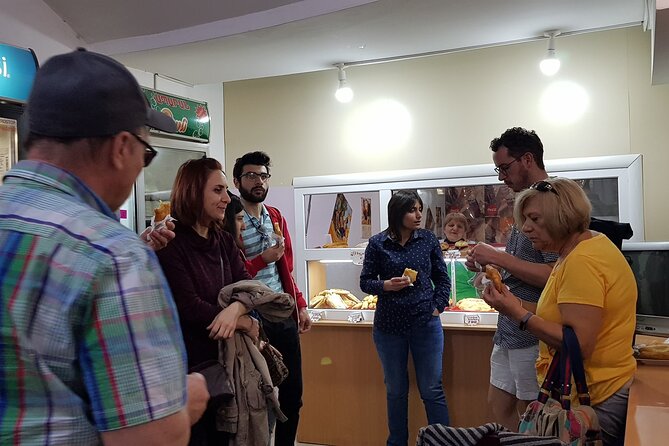
You will spend about 1 hour around the market. This is your sensory stop: you get the sights, the smells, and the chance to see how people buy and sell daily. It is also where the tour gives you real, tangible Soviet-era food context, because you are not only reading about diets and routines. You are tasting.
The included snack is perashki and ponchik. These sweets are simple, satisfying, and easy to eat while you walk and look. You can use the tasting moment like a reset button, especially if you have been sight-watching for a while.
Practical note: markets are busiest when you least want to wait. The tour timing is set, but still, build in patience and keep your phone accessible. You will want quick photos of stalls and product displays.
Stop 4: Beknazarian Street and the CCCP apartment district feel
From the market, you move into a residential slice of Soviet-era Yerevan on Beknazarian Street, exploring what is described as the CCCP (USSR) district.
This stop focuses on housing, specifically the “proletariat” apartment blocks meant to house workers. You are not just looking at buildings. The guide explains the story behind the last buildings built in Soviet times, which changes how you read the architecture. Even if you are not an architecture person, this angle makes the buildings feel connected to a specific moment in history rather than generic gray Soviet concrete.
There is also a food payoff here. You get to taste Soviet ice cream, a small but memorable way to translate the theme from civic life to everyday treats. Food works like time travel here. The taste anchors the story in something your brain can file away quickly.
Time at this stop is about 30 minutes. That is enough for one careful walk-and-look loop plus photos. If the buildings catch your eye, ask the guide where to look for clues about what period you are seeing.
Stop 5: The Children’s Railway, built in 1937 and still running
The final stop is the most charming in both theme and design: the Children’s Railway.
This railway sits between the Hrazdan river and the Hrazdan water canal, and it is described as one of the children’s railways that existed in the USSR and continued functioning after the breakup. The railway was built in 1937, which alone makes it a rare find in a city tour.
What you can see here is part of the appeal. The original main station building and the first 1937 locomotive are still intact. That matters because you are not dealing with a recreated set. You are looking at something that has persisted for decades.
Your time allocation is about 40 minutes, and the admission ticket for this stop is included. This makes the overall tour feel more complete, because you are not only touring Soviet landmarks. You are experiencing a Soviet-era place still used for its original spirit: learning, excitement, and hands-on play.
If you like trains, you are going to have a good time. If you do not, the stop still works because it shows how the USSR treated education and youth activities as something physical and structured.
Who this tour suits best
This is for you if you fall into one of these groups:
- You want a Soviet Yerevan perspective that includes daily life, not just monuments.
- You like guided stories that connect history to what you can actually see on the street.
- You enjoy small group experiences, with time to ask questions and take photos.
- You want an easy half-day plan with food included and a clear route.
It is also a great fit for first-time visitors who already have a feel for central Yerevan and want a different angle. Republic Square is a familiar starting point, but the rest of the route pulls you outward to transit spaces, markets, residential districts, and the kids railway.
If you are only interested in Armenia’s post-Soviet evolution, you might find the Soviet focus limiting. Still, even then, housing districts and transit stations can help you understand why the city looks the way it does today.
Practical tips to get the most from the 4-hour format
This tour runs about 4 hours, so plan your day like a focused outing. You will want to travel light and keep your pace steady, especially at the market and during the railway stop.
Bring:
- Comfortable shoes for walking near the market and around station areas
- A snack-level appetite, because perashki and ponchik are part of the experience
- A camera or phone with enough battery, since there are multiple photo-friendly stops
A small-group tour also means you should be ready to pause. The best Soviet storytelling happens when the group slows down for details. If you try to multitask too hard, you may miss some of the context the guide is building.
Value check: what you get for $65
Here is the value in plain terms. At $65, you are paying for:
- A local expert guide
- Included food tasting at the market (perashki and ponchik)
- Metro ride and a Soviet-style van
- Children’s Railway admission ticket included
- The other listed stops are free, like Republic Square areas and metro/CCCP district segments
That is a strong setup for a half-day. You get transportation support, guided context, and at least one included ticket. If you were to do it on your own, you would still have to pay for transit, admission, and a lot of the “why this matters” part would be on you to research.
Should you book Soviet Yerevan?
Yes, if you want a small-group Soviet Yerevan story that moves beyond statues. This route is practical, varied, and well paced for a half-day plan: Republic Square for the big symbolism, a metro stop for Soviet transit planning, a market stop where you taste local sweets, an apartment-district look at housing history, and a 1937 Children’s Railway to cap it off.
I would skip it only if you want a purely scenic walk with minimal context, or if you are not interested in how Soviet systems influenced everyday routines. Otherwise, it is an efficient way to see Yerevan as a city shaped by multiple eras.
FAQ
What is the duration of the Soviet Yerevan tour?
It lasts about 4 hours.
How much does the tour cost?
The price is $65 per person.
Is the tour offered in English?
Yes, the tour is offered in English.
What is the maximum group size?
The tour has a maximum of 6 travelers.
What is included in the price?
The price includes a local expert guide, snacks (perashki and ponchik), public transportation (metro ride and a Soviet-style van), and the admission ticket for the Children’s Railway.
Are admission tickets required for the stops?
Republic Square, Sasuntsi Davit Street, Malatia-Sebastia, and Beknazarian Street are listed as free. The Children’s Railway admission ticket is included.
Where does the tour start and end?
It starts at Ministry of Foreign Affairs, Government House #2, Republic Square, Yerevan. It ends at Diana Abgar Park, Arami poghots, Yerevan.
When is the tour available?
The published opening hours are Mondays from 10:00 AM to 2:00 PM, within 11/12/2025 to 01/13/2027.
Can I cancel for a full refund?
Yes. Cancellation is free up to 24 hours in advance for a full refund. If you cancel less than 24 hours before the start time, the amount is not refunded.
Newest listings across Yerevan
- Yerevan’s Sights: Guided Walking Tour★ 5.0 · 1 review
- Yerevan tour in a retro Lada with drinks (Yerevan city tour)★ 5.0 · 1 review
- Private transfer Yerevan-Tbilisi-Yerevan in one day★ 5.0 · 1 review
- Private tour to Saghmosavank, Karmravor, Oshakan, Hovhannavank★ 5.0 · 1 review
- Day Tour to Amberd Fortress Aragats and Kari Lake From Yerevan★ 5.0 · 1 review
- Yerevan Walking Architecture Tour★ 5.0 · 1 review
- Armenia – Guaranteed Departure – Book Now! – 2025★ 5.0 · 1 review
- Mother Cathedral of Holy Echmiadzin★ 5.0 · 1 review
City Tours, compared.

Yerevan city tour with drinks in a classic car with photography
Read our review →
Private Tbilisi Tour from Yerevan (main sights of old and new city, cable car)
Read our review →
Private Yerevan City Tour: Erebuni, Matenadaran & Tsitsernakaberd Museums
Read our review →
Walking Yerevan City Tour with 5 Wine & 10 years-old brandy
Read our review →
Private tour to Tsaghkadzor city (Ropeway), Lake Sevan, Sevanvank, Dilijan
Read our review →
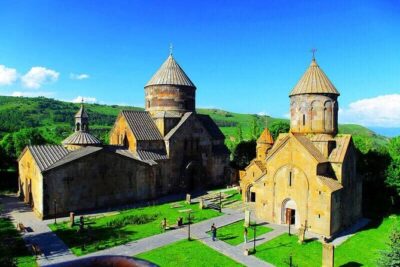
Private Tour to Tsaghkadzor city (Ropeway) and Kecharis Monastery
Read our review →Browse the lists this tour appears in